
Humanoid Robots in Manufacturing: What They Can Actually Do in 2026
Humanoid robots have moved from demo stages to live production lines at BMW and Schaeffler. Here's what they're actually doing on the factory floor today, where the technology still falls short, and how to evaluate a pilot without buying the hype.
Humanoid Robots in Manufacturing: What They Can Actually Do in 2026
For most of the last decade, humanoid robots on a factory floor meant a trade-show demo, not a production line. That changed in 2026. BMW ran Figure's F.02 robots on live shifts at its Spartanburg plant, and German auto-parts giant Schaeffler signed a deal to put thousands of wheeled humanoid units into its own plants starting this year. This post separates what's actually deployed from what's still marketing, and gives you a framework for deciding whether a pilot makes sense for your operation.
From Trial to Production: What Actually Happened
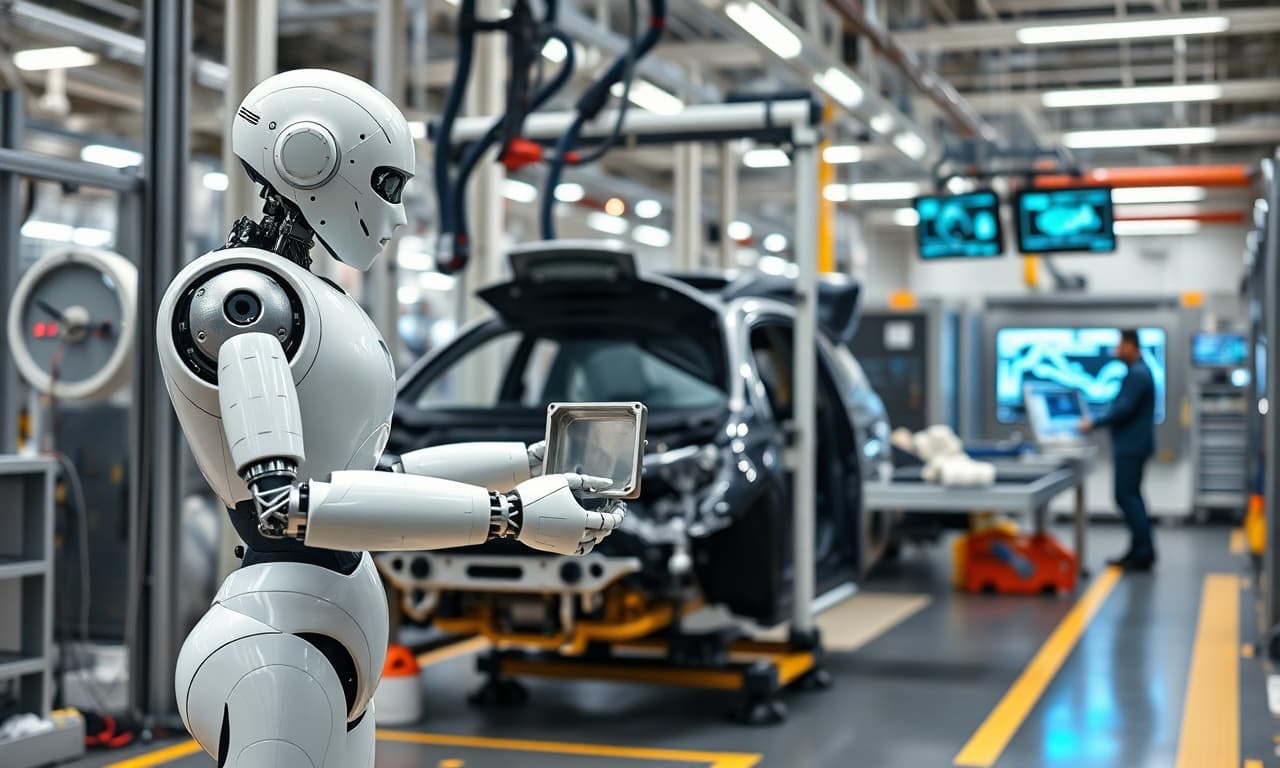
BMW Group's Spartanburg plant ran the clearest public test to date. Over several weeks, Figure's F.02 robots worked 10-hour shifts, Monday through Friday, inserting sheet-metal parts into fixtures for chassis assembly - a task BMW flagged as ergonomically demanding for human workers. By the end of the trial the robots had logged 1,250 hours of run-time, loaded more than 90,000 parts, walked roughly 200 miles inside the plant, and contributed to the production of over 30,000 BMW X3 vehicles (BMW Group, Figure). BMW has since moved to a follow-on pilot with Figure's newer F.03 model at Spartanburg and a separate pilot at its Leipzig plant in Germany, under a newly created "Center of Competence for Physical AI in Production."
The other landmark deal is commercial rather than experimental. In May 2026, UK robotics company Humanoid signed an agreement with Schaeffler to deploy a four-digit fleet - reporting suggests 1,000 to 2,000 units - of wheeled-base humanoid robots across Schaeffler's global plants by 2032, starting at two German sites between December 2026 and June 2027 (RoboticsTomorrow, DC Velocity). The first task assigned to those robots isn't dexterous assembly - it's box handling, a logistics task closer to what an AMR already does today. Schaeffler is also supplying more than half of Humanoid's actuator demand through 2031, under a robot-as-a-service pricing model rather than a capital purchase.
Elsewhere, volume is coming from Asia. Unitree shipped roughly 5,500 humanoid units in 2025, the highest volume of any single manufacturer, largely into electronics and light-assembly lines. XPENG's IRON humanoid began mass production at its Guangzhou facility on January 1, 2026, initially for internal use in XPENG's own automotive plants.
What "Humanoid" Actually Buys You
The reason to reach for a two-legged, two-armed robot instead of a cheaper fixed-base arm or a wheeled AMR is narrow and specific: it can go where a person goes and hold tools a person already uses, without retooling the workstation. That matters on lines built around human ergonomics - narrow aisles, pedal-operated fixtures, tools sized for a human grip - where redesigning the cell for a conventional robot arm would cost more than the robot itself.
That's also why the deployed tasks so far cluster around a narrow band: overhead and under-body panel insertion, kitting and part sequencing, box and tote handling, and quality-inspection assistance. These are jobs that are physically awkward for people, low-risk if the robot gets it wrong, and don't require the sub-millimetre repeatability of a welding or precision-machining arm. None of the current deployments involve humanoids doing safety-critical or tight-tolerance work unsupervised.
Under the hood, what makes 2026's robots different from the humanoids of five years ago is the software, not the hardware. BMW and others describe this as "physical AI" - vision-language-action models trained on demonstration data that let a robot generalise a grasping or insertion skill across slightly different part variants, rather than being hand-coded for one exact motion. It's the same underlying shift covered in our agentic AI in manufacturing piece: less scripted automation, more models making moment-to-moment decisions inside guardrails a human sets.
Where the Technology Still Falls Short
Three constraints show up in every serious deployment right now:
- Runtime. No commercially available humanoid completes a full 8-hour shift on one charge. Current platforms run in the range of 2-4 hours before requiring a recharge or a battery swap, which is why BMW's and Schaeffler's public plans lean on scheduled swaps or shift patterns built around charging windows rather than continuous single-shift operation.
- Reliability outside the lab. Manipulation tasks that work reliably in a controlled trial cell degrade when part variation, lighting, or fixture wear increases - the same brittleness that affects any perception-driven automation, humanoid or not. This is precisely why data readiness matters before you scale a pilot; see our data readiness guide for the checklist.
- Safety standards are still catching up. The most mature framework, ANSI/RIA R15.08, governs industrial mobile robots (AMRs and AGVs) and is being extended to cover wheeled humanoid platforms, but there is no finalised standard written specifically for bipedal, dexterous humanoids operating alongside people. Until one exists, humanoid pilots run under a case-by-case risk assessment, similar to how early cobot deployments worked before ISO/TS 15066 caught up with the hardware.
A Framework for Deciding Whether to Pilot One
Before treating a humanoid pilot as a strategic bet, run the task through the same filter you'd apply to any capital automation decision:
- Is the task ergonomically bad for a person but too variable for a fixed-base robot arm? If yes, humanoids are worth evaluating. If the task is repetitive and fixed-geometry, a conventional arm or a purpose-built fixture will be cheaper and more reliable.
- Can the workstation tolerate a 2-4 hour operating window per charge? If the task runs on a line that can't pause for swaps, you need a multi-robot rotation or it isn't ready yet.
- What does downtime actually cost you? Run the numbers through the OEE calculator for the line in question before committing capital - a humanoid that adds even a modest availability hit on a bottleneck station can erase the labour savings.
- What's the payback period against a robot-as-a-service contract versus a capital purchase? Most current deals, including Schaeffler's, are structured as RaaS specifically because reliability and useful life are still unproven. Model both scenarios in the ROI calculator rather than the vendor's own numbers.
- Do you have a documented safety review, not just a vendor risk assessment? Given the standards gap, treat a humanoid pilot the way you'd treat a novel piece of unlisted equipment - independent risk assessment, defined exclusion zones, and a rollback plan.
Analyst forecasts for the category vary wildly by design, which is itself a signal of how early this still is: Goldman Sachs projects over 250,000 humanoid shipments in 2030, nearly all industrial, growing into a $38 billion market by 2035, while Morgan Stanley models a $5 trillion market by 2050 with adoption not meaningfully accelerating until the mid-2030s (Goldman Sachs, Morgan Stanley). Neither firm is describing a technology ready for unattended, high-mix, high-tolerance work today.
The Bottom Line
Humanoid robots earned their way onto real production lines in 2026, but in a narrow, well-defined role: augmenting people on ergonomically bad tasks within a supervised, time-boxed shift, not replacing a production system. If you're evaluating a pilot, start with the task-fit questions above rather than the robot's demo reel, and treat the current generation as a labour-augmentation tool with a real payback calculation - not a general-purpose worker. For the broader shift in how AI systems are earning operational trust on the shop floor, see our glossary entry on agentic AI and the Industrial AI category on this site, or explore our courses for a structured path into smart manufacturing fundamentals.