
Time-Sensitive Networking Explained: How TSN Puts Real-Time Control on Standard Ethernet
Standard Ethernet was never built to guarantee when a packet arrives - which is exactly what motion control needs. Here's how the IEEE 802.1 TSN standards fix that, what they enable on the factory floor, and how to start without over-engineering your first network.
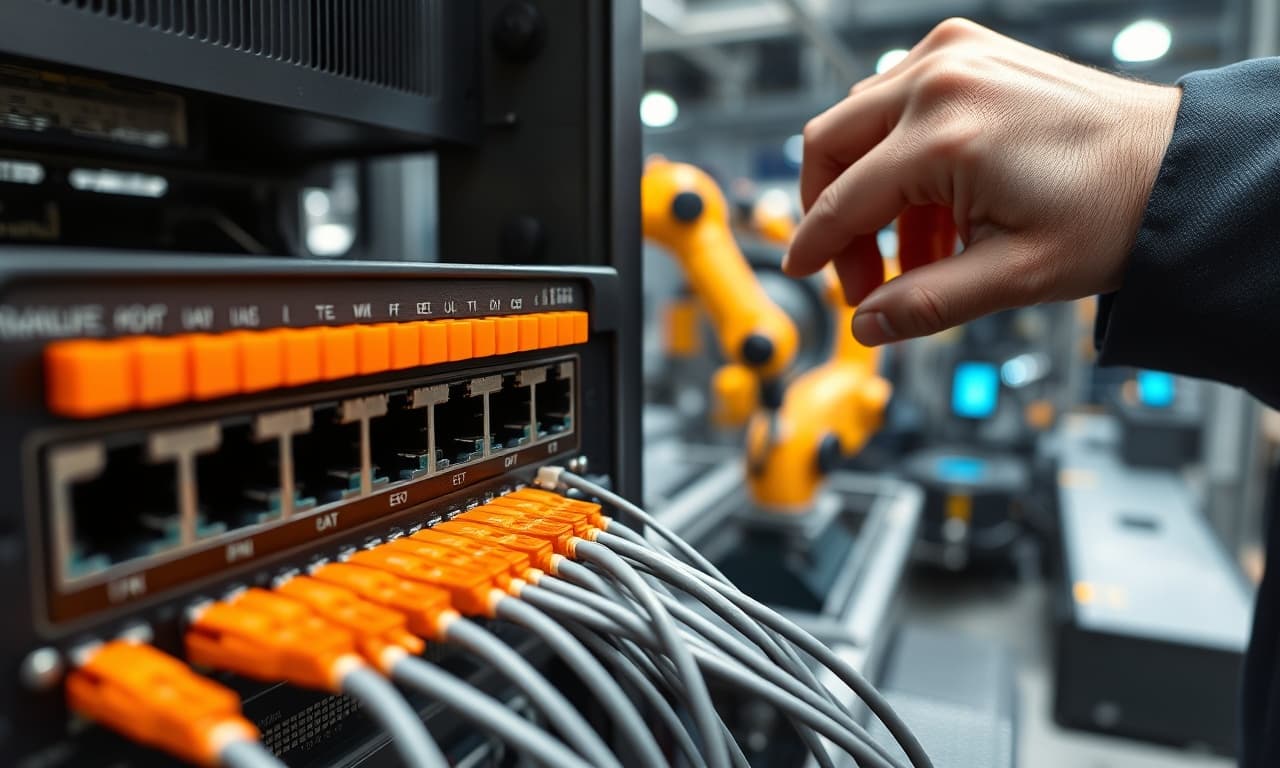
Time-Sensitive Networking Explained: How TSN Puts Real-Time Control on Standard Ethernet
Standard Ethernet was built on a simple promise: packets get delivered, eventually, as fast as the network can manage. That's fine for a file transfer or a web page. It's not fine for a servo drive that needs its next position command every 250 microseconds, without fail, forever. For decades that gap forced manufacturers to run two separate worlds of cabling - proprietary, deterministic fieldbuses for motion and safety, and ordinary Ethernet for everything else. Time-Sensitive Networking (TSN) is the set of IEEE standards closing that gap, and in 2026 it's moving from spec documents into products you can actually buy and wire up.
We touched on TSN in our OPC UA explainer as the transport underneath OPC UA FX. This post goes one level deeper: what problem TSN actually solves, which standards do the work, and how to think about adopting it without turning your first project into a networking research exercise.
The Problem: Ethernet Was Never Deterministic
Standard Ethernet switches forward frames on a best-effort, first-come-first-served basis. Under light load that's invisible. Under real factory-floor load - a camera dumping a 10MB image, an MES sync, a burst of MQTT telemetry, all sharing a wire with a motion controller - a large low-priority frame can sit in a switch's egress queue just long enough to make a time-critical frame late. For file transfers, a few milliseconds of jitter is nothing. For a robot arm or a synchronized print head, it can mean a scrapped part or a safety fault.
The traditional fix was physical separation: PROFINET IRT, EtherCAT, or SERCOS on one dedicated network for motion, standard Ethernet on another for everything else. That works, but it means separate cabling, separate switches, and separate expertise to maintain both - and it makes converging OT and IT data harder, not easier.
What TSN Actually Adds
TSN isn't one standard - it's a toolkit of IEEE 802.1 amendments that layer determinism onto ordinary Ethernet hardware, so the same wire can carry motion control, safety, and best-effort IT traffic side by side. The core pieces:
- IEEE 802.1AS (time synchronization) gives every device on the network a shared, precise clock - a profile of the Precision Time Protocol tightened for industrial use. Without a common clock, none of the scheduling below is possible.
- IEEE 802.1Qbv (the time-aware shaper) is the mechanism most people mean when they say "TSN." Each switch port gets a repeating schedule of open and closed gates for up to eight traffic queues, so a specific slice of every cycle is reserved exclusively for time-critical frames. A 1ms cycle might reserve 100μs for motion control and let everything else share the remaining 900μs.
- IEEE 802.1Qbu, paired with IEEE 802.3br (frame preemption), lets a switch pause a large low-priority frame mid-transmission to let an urgent frame through, then resume the interrupted one afterward - instead of wasting bandwidth on a "guard band" that blocks transmission entirely before every scheduled slot.
- IEEE 802.1Qcc (centralized configuration) provides a controller-based way to discover the network's topology, collect each application's timing requirements, and program every switch's schedule automatically - an SDN-style model adapted for real-time industrial networks, rather than hand-configuring gate schedules switch by switch.
- IEEE 802.1CB (frame replication and elimination) sends duplicate frames down two independent physical paths and silently discards whichever arrives second, giving safety-critical traffic failover with no reconvergence delay if a cable or switch fails.
Put together, these standards let one converged Ethernet network carry a servo loop, a safety interlock, an MQTT-based Unified Namespace feed, and a plain-old MES connection - with guarantees, not hope, that the time-critical traffic gets through on schedule.
Where This Shows Up on the Factory Floor
The most visible near-term use case is exactly the one we flagged in the OPC UA post: OPC UA FX, the OPC Foundation's push to extend OPC UA down to controller-to-controller and controller-to-device communication, uses TSN as its real-time transport. That's the mechanism intended to let multi-vendor motion control and safety traffic finally interoperate the way OPC UA already does for supervisory data - instead of every automation vendor maintaining its own proprietary real-time fieldbus.
TSN is also the layer underneath the industrial Ethernet protocols manufacturers already run: PROFINET, EtherNet/IP, and CC-Link IE TSN all have profiles that run over the same standard TSN switching fabric, which is what makes multi-vendor convergence realistic rather than aspirational. The CC-Link Partner Association has been integrating TSN into its ecosystem since 2018, and per reporting from IIoT World, more than 3,800 products from 700-plus vendors now support TSN in some form - evidence this has moved past the demonstration stage.
A Worked Example: Consolidating a Machining Cell's Networks
Picture a CNC machining cell with three traffic types that historically ran on separate infrastructure: a synchronized multi-axis motion controller needing sub-millisecond updates, a vision system for in-process part inspection pushing multi-megabyte images intermittently, and a condition-monitoring gateway publishing vibration and temperature tags to a plant Unified Namespace every few seconds. Without TSN, that's typically two or three physically separate networks - a proprietary motion fieldbus, a vision-system LAN, and a general OT network - each with its own switches and cabling run to the cell.
With a TSN-capable switch at the cell, all three coexist on one physical network. The time-aware shaper reserves a fixed slice of every control cycle exclusively for motion frames, guaranteeing they're never delayed regardless of what else is happening. Frame preemption lets the multi-megabyte vision transfer use the remaining bandwidth without blocking a scheduled motion frame that arrives mid-transfer. The condition-monitoring traffic, lowest priority of the three, fills whatever's left. One network, one set of switches to maintain, and a documented, auditable guarantee - not a hope - that the motion traffic never gets starved by everything else riding along with it.
Market Momentum
TSN is past the early-adopter phase. The global TSN market was valued at roughly USD 564 million in 2025 and is projected to reach USD 709 million in 2026, growing at a 27.7% compound annual rate toward an estimated USD 5.0 billion by 2034, according to Fortune Business Insights - and manufacturing is projected to be the single largest end-user segment, holding roughly 31% of the 2026 market. That growth is being pulled by exactly the convergence pressure described above: manufacturers consolidating separate OT networks onto shared infrastructure as part of broader IT/OT convergence efforts.
How to Start Without Over-Engineering It
TSN is not a rip-and-replace project, and treating it like one is the most common way pilots stall. A few practical guardrails:
- Don't retrofit a stable, working fieldbus network just to add TSN. Adopt it where you're already installing new equipment or replacing aging infrastructure - new machine cells, new lines, or a planned network refresh are natural entry points.
- Start with vendor-native tooling. Most industrial Ethernet vendors expose TSN configuration through their existing engineering software rather than requiring you to hand-author IEEE 802.1Qbv gate schedules. Use it.
- Segment first, converge second. TSN makes network convergence possible; it doesn't make it automatically a good idea for every plant. The IEC 62443 zones-and-conduits model still applies - a converged TSN network needs the same security segmentation thinking a converged IT/OT network always has.
- Treat determinism as a requirement to specify, not assume. When evaluating new equipment, ask explicitly whether it supports TSN and which profile (PROFINET over TSN, EtherNet/IP over TSN, OPC UA FX) - it's a much smaller ask now than retrofitting later.
If you're building out the broader connectivity and data-architecture literacy this depends on, our glossary has short definitions for TSN and the related terms in this post, and our courses cover the IIoT fundamentals that TSN sits on top of.
TSN won't matter to every manufacturer this year. But if you're specifying new equipment, planning a network refresh, or watching OPC UA FX develop, it's worth understanding now - the standards are stable, the products exist, and the manufacturers deploying it are the ones who won't need a second network refresh in five years to get real-time convergence.